(Photo credit: Claire Cecil/Fourth Estate)
Mason earned the highest “green light” rating from the Foundation for Individual Rights in Education (FIRE) this past April after making changes to the Code of Student Conduct.
Joining the University of Virginia and the College of William & Mary, Mason is the third school in Virginia to receive the green light, and the twentieth school in the country. To achieve this, FIRE worked closely with the Mason Director of Special Diversity Projects Dennis Webster and law professor Todd Zywicki to revise seven different university policies. The changes include revisions to the sexual harassment, flyer posting and leafleting policies.
“Freedom of speech and expression goes to the core of what it means to be a university. There must be a place in society where people can air controversial ideas, even if that ruffles other people’s feathers. The university is that place,” Zywicki said.
The revisions to Mason’s code came after almost a decade of FIRE advocating for changes. The foundation began investigating the university in 2005, after a student was arrested for protesting military recruiters on campus. According to FIRE’s press release and a Washington Post article published that year, Tariq Khan, an Air Force veteran and student, silently protested the recruiters’ table by standing next to them wearing a “Recruiters Lie” sign on his chest and passing out handbills. After having the sign ripped off his chest by two other students, Khan was arrested for disorderly conduct by campus police and found in violation of a Mason policy that banned the distribution of publications that are “inconsistent with the mission of the University.” The American Civil Liberties Union (ACLU) planned to defend Khan in the ensuing litigation, though all charges against Khan were eventually dropped. FIRE also started to directly appeal to the university president during that time, Dr. Alan Merten, and found many of Mason’s policies unconstitutional.
Mason’s changes and rating come at a time when certain federal lawmakers, – like Rep. Bob Goodlatte (R-Roanoke) – media outlets, – like the Huffington Post – and academic organizations – like the American Association of University Professors – are claiming that universities around the country are making shifts towards the opposite direction, one that often chooses political correctness over freedom of expression.
“Something strange is happening at America’s colleges and universities,” wrote Greg Lukianoff, CEO of FIRE, and Jonathan Haidt, a professor at NYU, in a recent Atlantic article. “A movement is arising, undirected and driven largely by students, to scrub campuses clean of words, ideas, and subjects that might cause discomfort or give offense.”
Lukianoff and Haidt argue that college students’ sensitivities towards “microaggressions” and “trigger warnings” hurt students more than they protect them. According to the writers, the consequences of this hypersensitivity to discriminatory, provoking or controversial comments include an increasingly polarized political field, a workplace marred by constant litigation and a generation of new graduates unable to learn from those with whom they disagree.
In the past, the ACLU has defended the First Amendment rights of those who engage in offensive or bigoted speech, such as in Terminiello v. Chicago, the 1949 landmark case that ruled banning controversial or inciting speech to be unconstitutional.
Instead of imposing speech codes on the student body, the ACLU recommends on its webpage that campus administrators speak out against expression of bias and create an educational environment that “includes counter-speech, workshops on bigotry and its role in American and world history, and real—not superficial—institutional change.”
To organizations such as the Anti-Defamation League (ADL), a Jewish group that seeks to counter anti-Semitic and bigoted speech and actions, speech codes inhibit education only when they are overly broad.
According to the ADL’s website, “Abusive words aimed at aspects of a person’s core identity can seriously wound and particularly damage young people in the process of figuring our their own identity during college.”
ADL’s website suggests that universities enact more specific speech codes and policies that clearly separate speech used in the class with speech used in common areas and resident halls. They also suggest increasing penalties for alcohol related hate speech. If university administrators stay silent in the face of bigotry and discrimination, the ADL warns, students may feel increasingly marginalized and compelled to drop out of a school where they feel they do not belong.
To Zywicki, hate speech is an inconsequential concept, one impossible to identify with a clear definition, and thus, impossible to combat with a definite policy.
“‘Hate’ speech is just a conclusory term attached to speech that someone doesn’t like,” Zywicki said. “I really don’t agree with the patronizing idea that there are certain people whose sensitivities are so profound that they get special protection from getting their feelings hurt. Personally abusive or personally harassment [language] is a different matter, of course.”
Meghann Hansen, a psychology major, agrees with this sentiment, although with some reservations.
“Political correctness has taken over our society because individuals feel like they are entitled to the respect of everyone around them when respect should actually be seen as a two-way street,” Hansen said.
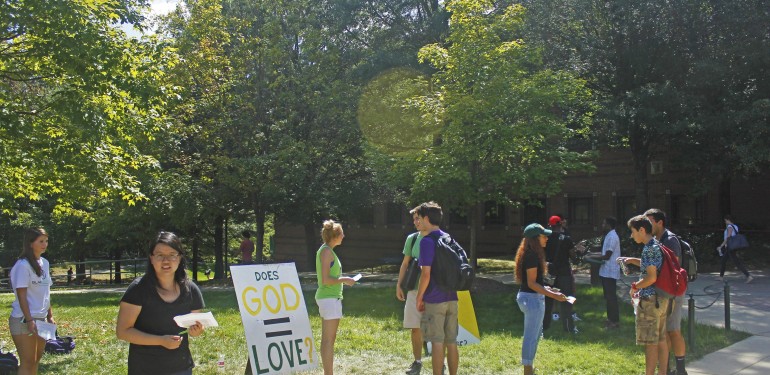
For campus groups like Intervarsity, a Christian fellowship organization, new policies might make it easier for the group to pursue its goals of ministry and spreading knowledge of Jesus.
“It’s really exciting because we can definitely encourage a lot more deeper conversations around campus,” said Joshua Anderson, a cyber security engineering major and member of Intervarsity, after hearing of Mason’s new policy. “Our whole goal is to have everybody learn about Jesus and what he’s done for us so knowing we can have those opportunities now, more than before, that’s a godsend in and of itself.”
After almost ten years of work and an overhaul of Mason’s freedom of expression policies, Zywicki believes the work is not over yet.
“Now of course the important thing is not to backslide. For example, James Madison had a green light rating for many years but recently changed its policies to a more restrictive policy and has lost that distinction,” Zywicki said. “It is now up to all of us—faculty, students, and staff—to remain vigilant to make sure that George Mason stands on its principles and doesn’t backslide.”
Kevin Dugan
Glad to see these changes, but hopefully they amount to more than making it easier for people to bother other students about Jesus.
Jitterbits
I know! How wrongly convinced of their own cultural marginalization must so many Christians be to think that in the United States there exists a substantial population completely unfamiliar with Jesus and the basic tenets of Christianity? Their scripturally proscripted role as martyrs “living in this world but not of this world”, a holy few besieged by a sinful majority, is a vital part of the evangelical’s and fundamentalist’s identities, but that they see themselves as besieged outcasts, in complete denial of Christian privilege in our culture, is quite astonishing and indicates how strongly perception shapes personal reality. I would frankly be surprised if there were a single person on campus having zero familiarity with this Jesus guy, although they often presume that anyone practicing Christianity differently is as ignorant and lost as the most unrepentant of atheists.
Aaron Hood
A letter in response to this article was written by Tariq Khan, who is mentioned as the key reason these changes began.
To the Editor:
I am writing concerning your September 14, 2015 article “Mason earns freedom of speech award after changes to student code.” I write because the article mentions a free speech violation that happened to me in 2005 when I was assaulted by civilians and police, arrested, and taken to jail for protesting military recruiters in the Johnson Center. In response to what vigilantes and police did to me, several student groups, the Faculty Senate, local activist groups, individuals, and national non-profits, including the Foundation for Individual Rights in Education (FIRE) – which the article references – courageously stood in my defense. I am grateful to all of those people and organizations, including FIRE.
That being said, some of what Greg Lukianoff, CEO of FIRE, and Jonathan Haidt, a professor at NYU, are quoted in the article as saying, triggered some alarm bells for me. Based on the article’s quotes of Lukianoff and Haidt, the two seem to be suggesting that “political correctness” and an aversion to “offensiveness” on the part of students are at the heart of the attacks on free speech we are seeing at campuses across the nation. I argue that such a notion is both wrong and harmful.
I am currently at the University of Illinois, Urbana-Champaign, where I am teaching an undergraduate US history class and working toward a PhD in history. Here at UIUC we are well acquainted with controversy concerning academic freedom and free speech. Last year the American Indian Studies Program hired Professor Steven Salaita. Under pressure from wealthy donors, Israel lobby groups, and establishment politicians, the Chancellor and the Board of Trustees stepped in and “unhired” Salaita, citing the supposedly “uncivil” tweets he posted criticizing Israel’s indiscriminate killing of civilians – including over 500 children – in Gaza last year. In response to this unprecedented move by the Chancellor and the BOT, 15 departments cast votes of no-confidence in the Chancellor and the BOT, an academic boycott of UIUC was launched (which has affected us greatly), the American Association of University Professors (AAUP) formally censured UIUC, and the university is currently mired in an expensive legal battle over the matter. I stand proudly with the American Indian Studies Program and the larger academic community in defense of Steven Salaita and the principles of academic freedom.
Was Salaita targeted because he was not “politically correct?” Was he targeted for being “offensive?” Was the campaign against him triggered by students who are uncomfortable with controversy? The answer to all three questions is no. Plenty of professors at UIUC have used swear words on social media with no repercussions, it was not liberals with supposed hypersensitivity about political correctness who raised their eyebrows about Salaita, and it was the student activist Left – the people who are supposedly policing uncomfortable language, according to Lukianoff and Haidt – who most boldly came to Salaita’s defense. The campaign against Salaita came not from below, but from above, from rich and powerful establishment interests.
Was the repression against me at GMU ten years ago caused by a culture of hypersensitive “political correctness?” Again, no. The incident in which vigilantes and police used violence to silence me was sparked by two right-wing extremist students calling me a “pussy” and a “faggot” and ripping the sign off of my chest. After brutalizing me and handcuffing me, one police officer said to me, “What with 9-11 and all, there’s no telling what you’ll do,” and another police officer yelled at me, “You people are the most violent people in the world!” At the jail, the officer threatened to hang me upside-down from the ceiling for “running my mouth.” The first people to come to my defense, and to the defense of free speech, were leftist students and professors, LGBT students, South Asian and Arab students, the very people who the right would have us believe are too “politically correct” and “sensitive” to tolerate free speech. It was the local right wing, the people who complain that society is “offended” too easily – fascist groups such as Free Republic, which later merged with other similar groups to become the Tea Party movement – who reveled in my arrest and called for more repression of students like me.
The flawed notion that overly-sensitive “PC” students are shutting down free speech is harmful. Student initiatives on campuses to challenge things such as racial or gender micro-aggressions are not challenges to free speech and they are not based on the idea that micro-aggressions are “offensive.” Micro-aggressions must be challenged because they are oppressive, not because they are offensive. “Oppressive” and “offensive” are not the same thing. Racist speech leads to an environment that is conducive to racist violence. It marginalizes students of color and makes the university not “uncomfortable,” but unsafe. Anti-LGBT speech makes campus unsafe, not merely “uncomfortable” for LGBT students. Misogynist speech creates an environment that is conducive to sexual assault. Any decent social scientist knows this. It is not about people being “uncomfortable” or “offended.” It is about people being unsafe and oppressed.
I was beaten, arrested, threatened, disrespected, and thrown in jail because I criticized US imperialism and militarism – two “isms” that GMU is deeply invested in. The Christian fundamentalists trying to bring everyone to Jesus, who were out there almost every day preaching were never arrested. The College Republicans with their capitalist, imperialist, white supremacist, patriarchal worldview were never arrested for being out there. The corporations handing out ads were never arrested for being out there. The anti-choice people were never arrested for being out there with their giant fetus pictures and their condemnations of women who have had abortions. The only people that got arrested for speech were me, with my anti-militarism/anti-imperialism, and the animal rights people protesting the abusive B&B Circus. So do not use what happened to me as an excuse to stand idly by, in the name of “freedom,” while white supremacists and Christian fundamentalists persecute students of color and LGBTQ students.
Sincerely,
Tariq Khan, GMU Alumnus
Pingback: [BLOCKED BY STBV] Pizza and Perspectives: A healthy discussion about free speech on campus | Fourth Estate
Mark Flanigan
It took 10 years for Mason to figure this out?