Taylor Wichtendahl, staff writer
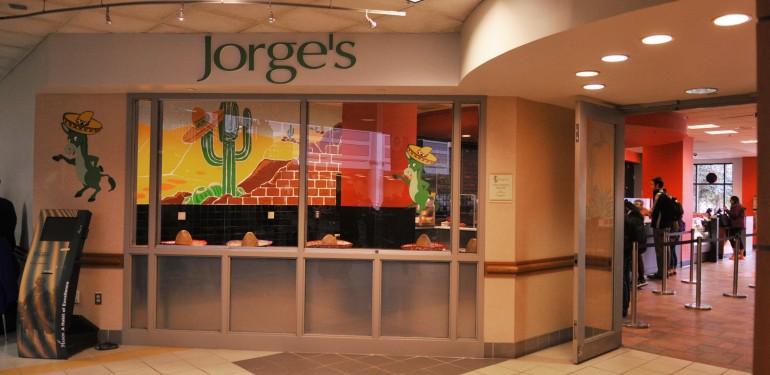
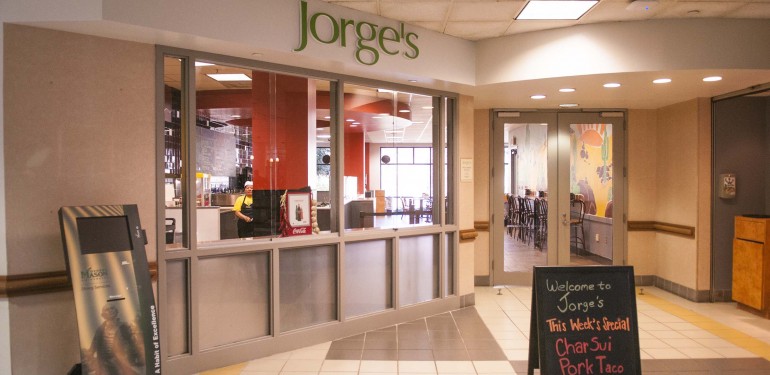
Jorge’s opened on Feb. 25 in the Johnson Center, in place of student favorite, La Patisserie.
Since it’s opening, students have voiced strong opinions through social media. Comments range from the taste of the food, to the signage, and to the restaurant itself.
@Mason_Dining Jorge's is dry food with a South Side twist that leaves you on the toilet thinking where you went wrong #masonfoodcritic
— R. Kelly (@alexdahuman) February 25, 2015
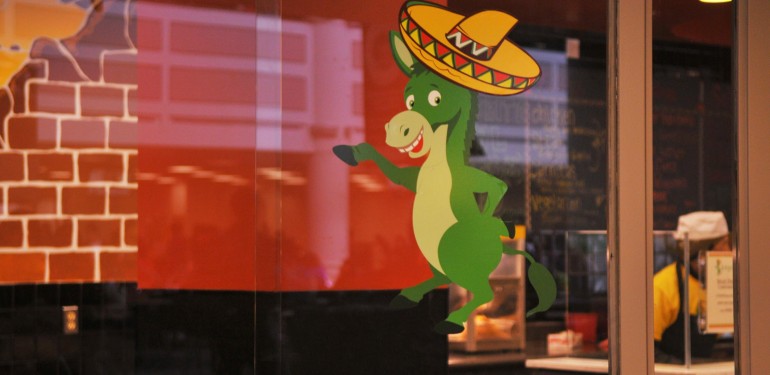
Btw masons new mexican joint in the JC is called Jorge's and is represented by a donkey and a sombrero #culturalappropriation #letsfixthat
— Jessica (@_catburglar) February 21, 2015
Mason Dining’s website describes Jorge’s as a “Mexican restaurant” serving burritos, tacos, and salads.
When asked for an interview regarding Jorge’s, Michel Wetli, General Manager of Mason Dining and a Sodexo employee, declined to comment. Since then, the logo at Jorge’s has been removed.
Charlotte Rothman, a global affairs major, said “[Jorge’s] is kind of the epitome of Mexican stereotypes.”
Students of Hispanic heritage are also weighing in on the culture issue.
Sydney Gorena, a freshman dance major, and Danielle Scalia, a freshman business major, both have eaten at Jorge’s this semester. Gorena is from Bolivia and Scalia is from Brazil.
“I think with as many Hispanic and/or Mexican restaurants as there are, we are used to it. But, I think someone coming here would take offense,” Gorena said.
Gorena raised the question, for such a diverse school, should not Mason be more culturally sensitive?
Jennifer Crewalk, the coordinator for Hispanic Latino Leadership Alliance, polled members anonymously in order to see where Mason students of Hispanic Latino heritage stood on the issue.
“[HLLA] goals are to empower, educate, and advocate within our diverse Mason community through the sharing of our cultural virtues, civic leadership, and meaningful connections.”
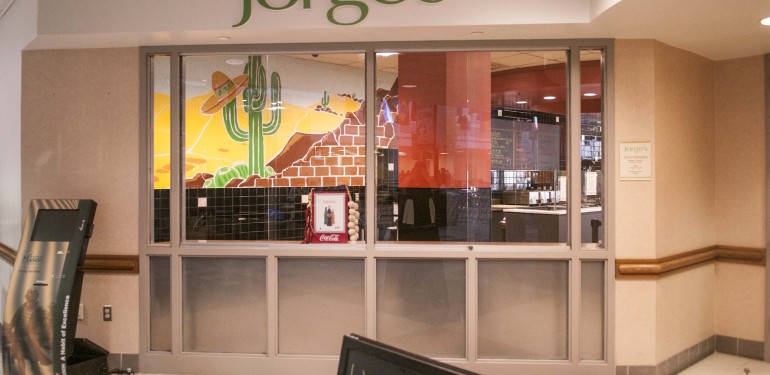
Of the nine student members polled, the general consensus was that Jorge’s logo, a donkey wearing a sombrero, was racially offensive. The students used words like “racist,” “disturbing” and “atrocious” to describe the logo and décor of the restaurant.
One student said that the logo negatively impacts the reputation of the restaurant. When asked if Jorge’s accurately represented Mexican culture, the response was similar in that most students found that Jorge’s does not represent Mexican culture.
Another student offered a possible solution for Mason to remedy the situation, saying, “Mexican culture is varied, bright, and has many expressions. Perhaps a mural maybe created instead by our own GMU students [would be a good replacement]? The logo and décor is offensive to me.”
While the HLLA’s opinions are not representative of the entire Hispanic population at Mason, many students seem to be concerned with the logo.
Using a donkey as a symbol for a Mexican restaurant has brought up the discussion of whether or not Mason is now responsible for helping to perpetuate a common Mexican stereotype.
“…Whoever designed the place clearly did not put any effort to research authentic Mexican patterns or designs to decorate the restaurant with,” Henry Lopez, a sophomore honors student studying computer science, said. “If a green donkey and sombreros is their interpretation of Mexican cuisine and culture, then I am seriously concerned about who is making these costly decisions.”
Lopez, as well as some of the anonymous students from HLLA, indicated that they have not eaten at Jorge’s, citing the offensiveness as a reason.
Crewalk, who is also the Assistant Director of Diversity, Inclusion and Multicultural Education, said, “My hope is that we can learn a lot from this experience and work towards a genuine collaboration between Sodexo and our students to re-create Jorge’s space.”
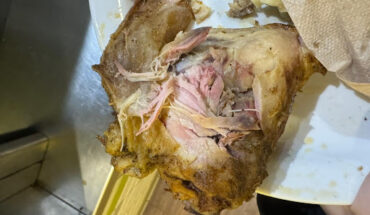
Many students have also mentioned that they are being charged Chipotle prices but receiving much lower quality food.
Rothman commented, “I think if you’re going to have a knock-off Chipotle, you might as well have the real thing.”
Gorena, who ate a chicken and rice bowl, found the food unappetizing.
“It’s kind of bland for what it’s advertising. I would prefer La Pat but I guess since Panera is there, they needed more variety,” she said.
Photos by Claire Cecil