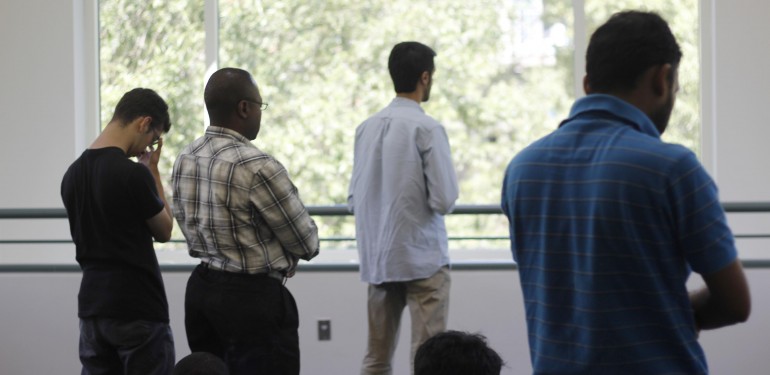
Complaints in previous years regarding overuse of the space by large groups such as the Muslim Student Association have urged people to refrain from leaving religious materials in the space so as to ensure an interfaith space.
With the 40-50 members that typically attend each prayer, the space often feels too small.
“It does get a little crowded,” said MSA President Yousaf Salim. “We are just trying to get a bigger space to more comfortably fit all that wish to attend our daily prayers.”
The MSA does reserve a larger space, such as George’s in the Johnson Center, for their formal Friday prayers and special holy days. However because of the frequency of their meetings, it is hard to secure larger spaces as often as they need and their requests for a bigger space have been difficult to get through to the university.
The MSA is not necessarily asking for their own space, however. Around 2004, the university offered them use of the JC Gold Room to use as their daily meeting place, which they declined.
“The board at that time said no because when you stuff all the Muslims on the lowest level, there is not enough exposure for Muslims to have an interfaith community,” Salim said.
A larger space would enable Muslims to practice more comfortably, while allowing a larger amount of other people who may feel intimidated by the size of MSA to use the space at the same time.
“We would just like a bigger space, such as the larger corner on the second floor of the JC. We do not want to have our own space. The more the faith communities are tied together, the better,” Salim said.
Mason’s “Quiet Meditation Area,” located on the third floor of the JC, is open to students and groups for any means of spiritual expression, religious or not.
“The space is intended for quiet meditation, so that is sort of by each person’s definition,” said Gail Sutton, the director of Student Centers. “This might be praying out loud or maybe internally. There’s really no stipulation in terms of the kind of activity that is intended to take place.”
The space is not geared toward one religion or one means of meditation and is unscheduled so as to allow for a fully integrated community of expression.
Since Mason is a state school, the construction of a building for a specific religion would violate separation of church and state.
However, the quiet meditation space is not designated as a religious space and it does not cost more for the university.
“With an empty space, nobody is charged extra, and there isn’t really an issue with special privilege since it’s also not discriminating between people who can use it,” said Cody Smart, a Ph.D. student studying religion in politics, government and society.
“I think having a quiet space for religious or meditative purposes is okay, especially since it confines itself to a small area and doesn’t demand too much of itself,” Smart said. “You do whatever you want there and [there’s] no presumption of anything but personal quiet time.”
The MSA, one of the larger religious organizations on campus, uses this space regularly, on most days up to four times a day, to hold their daily prayers. Though they are not the only group to use the space.
“No other groups go regularly. Sometimes there are a few people with yoga mats just sitting there quietly and meditating, I assume, but I do not see that often. Maybe once or twice a month,” Salim said.
Mason does not provide specific prayer or meditation materials, except for prayer mats that were funded by the Auxiliary Enterprise Management Council, an outside organization.
According to Mason’s University Life website, AEMC responds to “immediate university needs with direct impact on student’s daily lives outside of the normal budget cycle and parameters.”
“The rugs provide some definition in terms of where people are walking, and are intended to make pathways more clear for those walking around while others are meditation,” Sutton said.
Student centers allows those who use the space to leave their belongings “at their own risk,” according to Sutton.
This story was originally published in the Sept. 15 issue of Fourth Estate.